The Legal, Financial, and Ethical Risks of Manipulative Online Marketing
12/1/20254 min read
Ethical Online Marketing: What's Changing in 2026?
If you sell anything online in 2026, (coaching, consulting, digital products, programs, memberships, or services), ethical marketing is no longer just a “nice-to-have.” It is now a legal risk issue, a brand trust issue, and a platform survival issue.
Pressure selling, fake scarcity, emotional manipulation, and ND-shaming tactics are increasingly being scrutinized by regulators, payment processors, platforms, and consumers worldwide. Brands built on coercion are collapsing faster than ever. The businesses that are growing? They are the ones built on transparency, informed consent, and psychological safety. They are the businesses that were approved to be in the Neurovetted Directory of Ethical Online Service Providers.
Why Ethical Marketing Is Now a Business Survival Requirement
Short-term conversion spikes created through pressure tactics look impressive on spreadsheets. But the long-term fallout shows up as:
Elevated refund rates
Escalating chargebacks
Payment processor scrutiny
Loss of platform privileges
Public reputation damage
Legal exposure
These outcomes are no longer rare. They are predictable consequences of extraction-based marketing models.
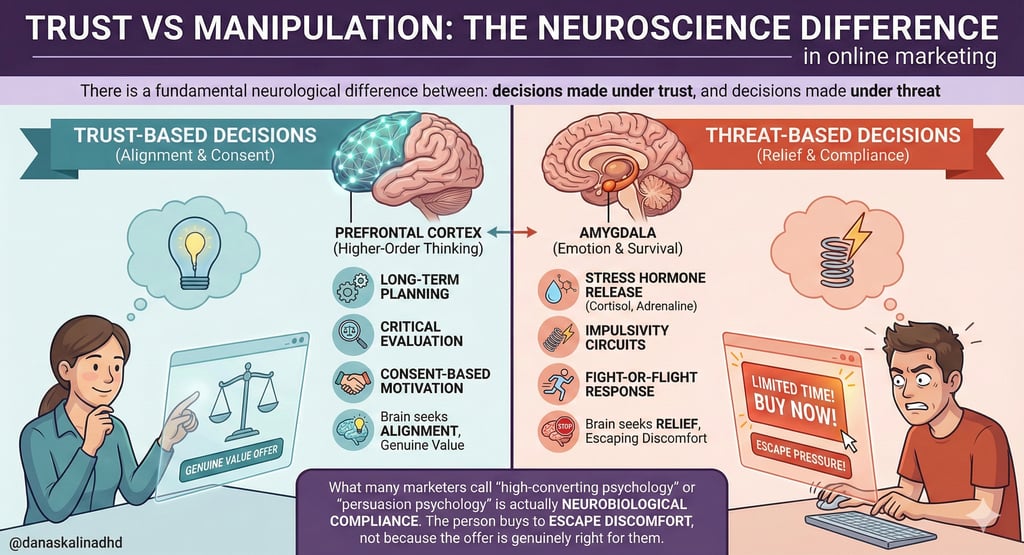
According to neuroscience, decisions made under psychological pressure activate threat and survival circuits in the brain rather than reflective reasoning (Arnsten, 2009; Phelps & LeDoux, 2005; Kahneman, 2011). Buyers are not choosing alignment, they are selecting temporary relief from emotional discomfort.
That distinction matters because threat-based buying reliably creates post-purchase regret, resentment, and refund behavior. Ethical marketing keeps the thinking brain online. Manipulative marketing intentionally shuts it down. And regulators are catching up.
The Global Legal Shift Toward Ethical Online Marketing
Most online business owners assume marketing ethics are subjective. They are not. Across multiple regions, ethical standards are now being codified into consumer protection law, privacy law, and deceptive marketing enforcement. Here is what every service provider must understand in 2026:
Canada: Competition Bureau + Anti-Deceptive Marketing Laws
Under the Competition Act, Canadian businesses are prohibited from:
False urgency
Misleading “limited availability” claims
Deceptive pricing
Exaggerated outcome claims
If you use fake countdown timers, manipulate waitlists, or claim “last chance” without verifiable proof, you may be violating federal law. Additionally, emotional deception that distorts a consumer’s ability to make an informed choice can trigger enforcement.
United States: FTC + INFORM Consumers Act
The Federal Trade Commission now aggressively enforces:
Deceptive advertising
False scarcity claims
Undisclosed testimonials
Emotional manipulation in vulnerable populations
The INFORM Consumers Act also requires truthful business disclosures, especially in digital commerce. Businesses are being fined, delisted, and permanently banned from payment processors for unethical marketing patterns — not isolated incidents.
United Kingdom: GDPR + Consumer Protection from Unfair Trading Regulations
In the UK, consumer consent must be:
Freely given
Fully informed
Not emotionally coerced
The Consumer Protection from Unfair Trading Regulations (CPRs) explicitly prohibit:
Aggressive commercial practices
High-pressure sales tactics
Misleading urgency
Emotional manipulation now qualifies as undue influence, a legally recognized coercive practice.
Australia: Australian Consumer Law (ACL)
Under ACL, businesses must not:
Make false or misleading representations
Create artificial urgency
Use deceptive psychological persuasion
Australian regulators routinely issue six-figure penalties for deceptive digital advertising and pressure-based conversion funnels.
New Zealand’s Fair Trading Act prohibits:
Misleading representations
Unsubstantiated urgency
Pressure-based selling that interferes with informed choice
Digital marketers operating internationally are often unaware they are legally accountable under multiple consumer protection frameworks at once.
Global Reality: You Are Regulated Where Your Clients Live
If you sell to international clients, you are subject to:
Their jurisdiction’s consumer law
Their privacy and consent standards
Their deceptive marketing enforcement rules
Ethical marketing is no longer optional when your audience is global (OECD, 2016/2023; FTC US SAFE WEB Act; GDPR Article 3; Competition Bureau Canada; ACCC Australia; UK CMA; NZ Commerce Commission). Cross-border consumer protection law consistently holds that businesses are regulated based on the location of their clients, not just where the business operates
Why These Tactics Are Especially Harmful to Neurodivergent Buyers
Neurodivergent clients experience structural vulnerability to:
Impulsivity
Rejection sensitivity
Emotional dysregulation
Time blindness
Decision fatigue
Pressure tactics, guilt-based selling, scarcity manipulation, and ND-shaming exploit these neurological realities. What is framed as “conversion psychology” in marketing culture is often neurological compliance under emotional threat (Arnsten, 2009; Tangney et al., 2007; Kahneman & Tversky, 1979; Cialdini, 2009; Barkley, 2015).
This is why Neurovetted™ explicitly classifies the following as prohibited tactics:
Fake countdown timers
“Last chance to fix your life” framing
Manufactured urgency
Shame-based messaging
Weaponizing ADHD and autism traits to provoke buying
These tactics do not increase empowerment. They increase harm.
What Ethical Online Marketing Actually Looks Like
Ethical marketing is not passive. It is structurally designed for informed consent. True ethical marketing includes:
Clear visible pricing
Transparent refund policies
Honest outcome framing
Accurate scope of service
Absence of manufactured urgency
Respect for financial boundaries
Ethical conversion does not rush, corner, shame, or emotionally leverage the buyer. It creates conditions where thoughtful evaluation is possible. Aligned clients stay longer, refer more often, create fewer disputes, and generate sustainable revenue. Coerced clients burn brands down (Reichheld & Sasser, 1990; Anderson & Sullivan, 1993; Tripp & Grégoire, 2011).
The Hidden Operational Risk in Manipulative Funnels
Many brands assume legality is the only concern. It is not. Manipulation also triggers:
Platform bans
Stripe and PayPal account closures
Chargeback monitoring flags
Payment reserve holds
Marketplace removal
Public consumer warnings
Once payment processors classify your business as “high risk,” recovery is extremely difficult.
For example, Visa explicitly confirms that in the in the Visa Chargeback Monitoring Program (VCMP) high dispute ratios trigger:
Monitoring programs
Financial penalties
Mandatory remediation
Possible termination of processing privileges
Once a merchant is placed in either the "High Risk", or "Excessive" Programs, removal is:
Time-bound
Conditional
Not guaranteed
Often followed by continued rolling reserves or account termination
Stripe also explicitly states that accounts classified as high risk may be:
Immediately terminated
Placed in rolling reserves
Denied reactivation
And Stripe is not obligated to reinstate terminated accounts. Bottom Line? Ethics, in 2026, is not just moral. It is operational risk management.
The Line the Online Industry Is No Longer Allowed to Cross
If your revenue depends on:
Rushing people
Shaming hesitation
Threatening missed opportunity
Triggering desperation
Creating false scarcity
Exploiting vulnerability
You do not have a marketing system. You have a compliance machine.
Neurovetted.com was created to define and uphold a clear boundary between ethical marketing and coercive conversion practices. Trust is now the only stable currency left.
Do Not Enter 2026 With Exposed Marketing Practices
If you are still using pressure, urgency, or emotional leverage to sell, 2026 is not going to be kind to your business. Regulation is tightening. Payment processors are watching. Consumer complaints are accelerating.
If your marketing has never been formally audited for ethical and regulatory risk, you are operating blind. You need to have an audit done today!
info@neurovetted.com
Copyright 2026
Neurovetted is a public directory only. Providers are independent businesses. Neurovetted does not guarantee services, outcomes, or results and is not responsible for transactions or disputes between users and providers.